Alexander Zemlinsky by Marc D. Moskovitz
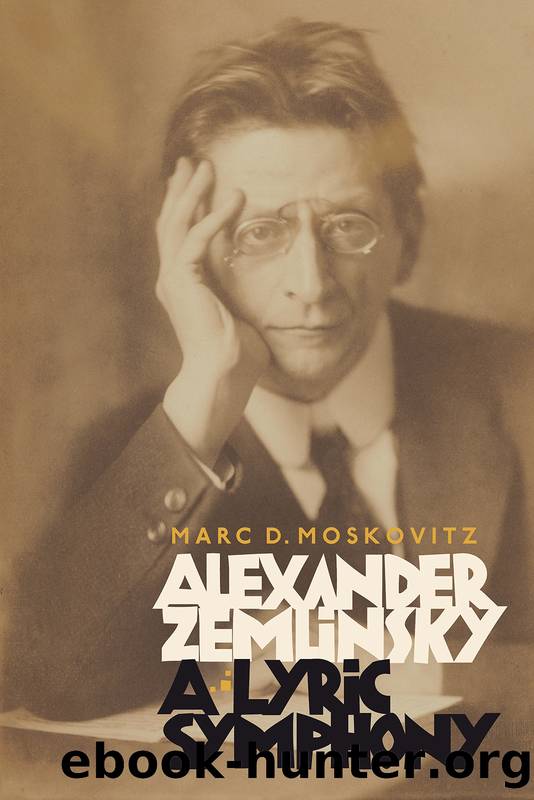
Author:Marc D. Moskovitz
Language: eng
Format: epub
Tags: Music, Modern History
Publisher: Boydell & Brewer Group Ltd
Published: 2013-04-09T00:00:00+00:00
***
There had once been a time when Zemlinsky gladly dedicated countless hours to societies whose missions promoted the cause of modern music. His commitment to the works of his contemporaries was unfailing and passionate, but now lifeâs demands consumed him, leaving little time for the organization and administration of such pursuits. Schoenberg, meanwhile, was boldly forging ahead, undaunted by war or the struggles he had repeatedly faced in Vienna. In November 1918, the month of the armistice that ended World War I, Schoenberg founded the Verein für musikalische Privataufführungen (Society for Private Musical Performances) in Vienna. Two years later he brought his ensemble to Prague for four performances. Inspired by what he heard, a local clerk and an amateur violinist by the name of Georg Alter attempted to establish a similar organization in the Czech capital. But Alterâs initial attempts to involve Zemlinsky produced a tepid response â despite the years that had elapsed, Zemlinsky no doubt remembered the volume of work such undertakings demanded, not to mention the struggles encountered building an appreciative audience for this music. But when Schoenbergâs ensemble returned for a performance of Pierrot lunaire a year later, Zemlinsky had a change of heart. The electric performance, which Zemlinsky described as an âunqualified great successâ,26 suggested Prague was ready to embrace such an undertaking.
The following spring, the Prague Verein für musikalische Privataufführungen was founded. At its charter meeting, Zemlinsky was elected president of the Prague Verein, Alter secretary, and Schoenberg honorary president. Thanks to the competent management of the gifted writer, conductor and publicist Erwin Stein, and to Anton Webern, who also led many of the rehearsals, the Verein contributed significantly to Pragueâs cultural landscape, despite surviving only three years.27 Modeled closely on Schoenbergâs Viennese society of the same name, the Prague chapter sought to further the cause of contemporary music through well-balanced programming and obligatory repeat performances. To ensure that the Verein maintained a consistently high level of performance, rigorous preparation for each program was the standard. Applause, demonstrations or disapproval would not be tolerated, as all performances were private and critical reviews prohibited. And as a policy, no single âschoolâ was permitted to dominate its programs. Rather, offering a wide variety of styles, the Verein strove to present its audiences with a true sense of the present state of contemporary western music.
Issues of programming and concert duration dominated much of Zemlinsky and Schoenbergâs correspondence during this period. Zemlinsky, of course, had the last word about artistic matters in Prague, but Schoenbergâs experiences with the Vienna Verein made him an invaluable resource. To avoid appearances of furthering his own cause, Zemlinsky intended to limit performances of his music, as Schoenberg had done in Vienna. With the Vienna Verein, Schoenberg compensated by offering up an abundance of Max Reger â his music appeared forty-two times in a single season â a decision Schoenberg justified by claiming that âReger must in my view be done often ; 1, because he has written a lot ; 2, because he is already dead and people are still not clear about him (I consider him a genius).
Download
This site does not store any files on its server. We only index and link to content provided by other sites. Please contact the content providers to delete copyright contents if any and email us, we'll remove relevant links or contents immediately.
| Biographies | Business |
| History & Criticism | Instruments |
| Musical Genres | Recording & Sound |
| Reference | Songbooks |
| Theory, Composition & Performance |
The Goal (Off-Campus #4) by Elle Kennedy(13681)
Kathy Andrews Collection by Kathy Andrews(11844)
Diary of a Player by Brad Paisley(7584)
Assassin’s Fate by Robin Hobb(6227)
What Does This Button Do? by Bruce Dickinson(6209)
Big Little Lies by Liane Moriarty(5807)
Altered Sensations by David Pantalony(5106)
Pale Blue Dot by Carl Sagan(5012)
Sticky Fingers by Joe Hagan(4204)
The Death of the Heart by Elizabeth Bowen(3625)
The Heroin Diaries by Nikki Sixx(3552)
Confessions of a Video Vixen by Karrine Steffans(3312)
Beneath These Shadows by Meghan March(3311)
How Music Works by David Byrne(3272)
The Help by Kathryn Stockett(3152)
Jam by Jam (epub)(3095)
Harry Potter 4 - Harry Potter and The Goblet of Fire by J.K.Rowling(3076)
Computational Linguistics and Intelligent Text Processing: 20th International Conference, CICLing 2019 La Rochelle, France, April 7â13, 2019 Revised Selected Papers, Part I by Alexander Gelbukh(2996)
Strange Fascination: David Bowie: The Definitive Story by David Buckley(2873)
